
Build a Stronger, More Valuable and More Sellable Business
Most owners only discover what their business is worth when they are ready to sell. By then, it is too late to fix what reduces value or weakens buyer confidence. ETSC Insights, Powered by Value Builder, changes that.
What is the Value Builder System?
The Value Builder System is a business improvement and exit preparation framework used by over 80,000 business owners worldwide. It starts with an assessment of your business across the key factors that influence company value.
It then provides a structured roadmap for improving those areas. In simple terms, it answers three questions:
| Question | Why it matters |
|---|---|
| How valuable is my business today? | You need a realistic starting point before making major decisions about growth, investment, or exit. |
| What is reducing the value of my business? | Many value leaks are hidden until a buyer, funder, or due diligence process exposes them. |
| What can I do to improve value before sale? | The best results usually come from preparation well before going to market. |
Profit matters, but buyers also look at earnings quality, growth potential, customer dependency, recurring revenue, and how well the business runs without the owner.
What Drives the Value of Your Business?
The Value Builder Score assesses your business across eight key drivers. Improving even two or three before going to market can materially increase your exit value.
Businesses scoring above 80 receive offers 71% higher than average. Those scoring 90 or above receive offers 7.1× higher.
Financial Performance
The strength, consistency, and quality of your financial results. Buyers want confidence that the business is profitable, well managed, and financially reliable.
Growth Potential
The realistic opportunity for future growth. A business that can grow beyond its current level is usually more attractive than one that has reached a ceiling.
Switzerland Structure
The level of dependency on any one customer, supplier, or employee. Reducing concentration risk makes the business more resilient and less vulnerable.
Valuation Teeter-Totter
The relationship between cash flow and working capital. Better cash flow management can improve stability and increase buyer confidence.
Recurring Revenue
The extent to which income is predictable and repeatable. Recurring revenue makes a business more valuable because future income is easier to forecast.
Monopoly Control
The strength of your differentiation and market position. Buyers value businesses with a clear niche, defensible advantage, or reason customers choose them over competitors.
Customer Satisfaction
The loyalty and satisfaction of your customers. Strong customer relationships support growth, retention, and buyer confidence.
Hub & Spoke
The degree to which the business depends on the owner. A company that can operate without the owner is easier to sell and typically commands a higher price.
Take the free Sellability Score assessment to see where you stand →
The 12 Modules: A Structured Route to Improving Business Value
Each module focuses on a practical area of value creation and exit readiness. The objective is a clear improvement plan that can be acted on before the business goes to market.
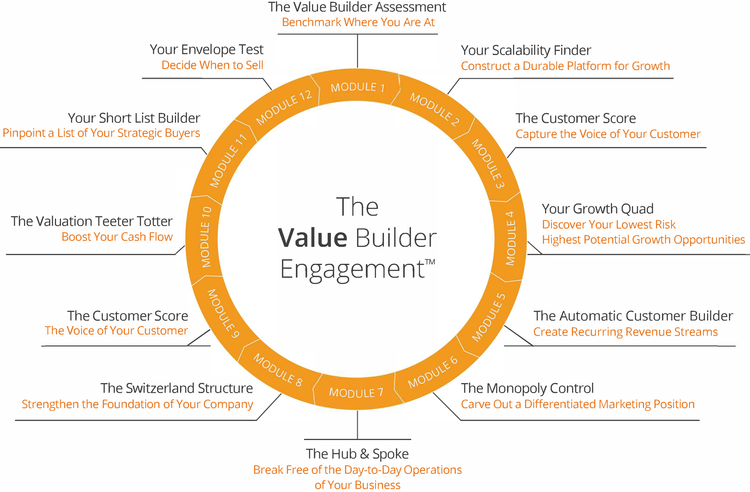
| # | Module | Focus | What you gain |
|---|---|---|---|
| 1 | Value Builder Assessment | Establishes your current Value Builder Score across all eight drivers. | A clear starting point and an objective view of the business from a buyer's perspective. |
| 2 | Scalability Finder | Identifies which products, services, or revenue streams have the strongest potential to scale. | Focus time and investment on the parts of the business that can grow without excessive owner involvement. |
| 3 | Customer Score | Measures customer satisfaction and loyalty against high-growth benchmarks. | Evidence of customer strength and early sight of issues that could affect retention or growth. |
| 4 | Growth Potential | Reviews where future growth is most realistic and least risky. | A credible growth story that can support a stronger valuation. |
| 5 | Recurring Revenue | Identifies opportunities to make income more predictable and repeatable. | Improved financial stability and a more attractive profile for buyers. |
| 6 | Monopoly Control | Clarifies what makes the business different and difficult to replace. | Stronger market positioning and a clearer case for why a buyer should value the business above ordinary competitors. |
| 7 | Hub & Spoke | Assesses how dependent the business is on the owner. | A business that can run without the owner at the centre of every decision. |
| 8 | Switzerland Structure | Reviews dependency on individual customers, suppliers, or employees. | Reduced concentration risk and a more robust business during due diligence. |
| 9 | Customer Satisfaction Survey | Gathers deeper customer feedback and benchmarks sentiment. | Useful evidence for improvement, retention planning, and future buyer discussions. |
| 10 | Valuation Teeter-Totter | Focuses on cash flow, working capital, and the financial mechanics of the business. | Reduced cash pressure and improved quality and reliability of earnings. |
| 11 | Short List Builder | Identifies the types of strategic buyers who may have a reason to acquire the business. | Helps shape the business around what future buyers are likely to value. |
| 12 | Envelope Test | Clarifies the owner's personal goals, exit expectations, and life after sale. | Ensures the business plan and exit strategy support what the owner actually wants from the transaction. |
Experience and Commercial Judgement — Not Just a Score
A score is only the starting point. What matters is knowing which issues are most important and which improvements will have the greatest commercial impact.
ETSC brings together formal business valuation expertise, 30 years of M&A experience, and deep understanding of how buyers actually assess businesses.
Zach Dogar is a Fellow of the Institute of Consulting — a designation that reflects the ability to translate complex analysis into decisions clients can act on. Combined with formal M&A and valuation qualifications and 30 years of transaction experience, the Value Builder findings are interpreted through the lens of what buyers actually do and what improvements will have the greatest commercial impact.
The assessment leads somewhere. We connect the findings to valuation, buyer behaviour, deal structure, and transaction management. See what clients say →
| What you receive | |
|---|---|
| Structured Value Builder assessment | A clear view of the current strengths and weaknesses of your business. |
| Practical improvement roadmap | Prioritised actions rather than trying to fix everything at once. |
| One-to-one advisory support | Experienced guidance to interpret results and make commercial decisions. |
| Valuation and sale-readiness insight | Improvements considered in the context of how buyers and acquirers think. |
| Pre-sale preparation | Issues addressed before they affect buyer confidence or deal value. |
| Stronger exit strategy | Business preparation, personal objectives, and sale timetable aligned. |
Start With a Free Assessment
Three free assessments. Each takes around 15 minutes and produces a scored result benchmarked against 80,000+ businesses.
Sellability Score
How attractive is your business to a buyer? Scored across all 8 value drivers and benchmarked against businesses that have sold.
Take the assessment →Personal Readiness to Exit
Are you personally ready to exit? This assessment looks beyond the business to your own readiness for transition.
Take the assessment →Freedom Score
Is your business giving you the financial and personal freedom you are building toward? Identify where owner dependency is suppressing your options.
Take the assessment →How a Typical Engagement Works
The depth and pace depends on your objectives and timeline. A typical engagement works as follows:
Initial Discussion
A confidential conversation about your objectives and timescale — no obligation, just clarity on whether this is the right programme.
Value Builder Assessment
You complete the assessment and we review the key drivers. This establishes a clear baseline and identifies the areas most worth improving.
12-Module Programme
One module per month covering growth, risk, owner dependency, cash flow, differentiation, and buyer attractiveness — with ETSC advisory support throughout.
Valuation and Preparation
We connect the findings to formal valuation, due diligence preparation, and market positioning.
Exit or Growth Roadmap
Whether your exit is imminent or years away, you leave with a practical path forward. For owners earlier in the journey, this connects directly to our Endgame Planning service.