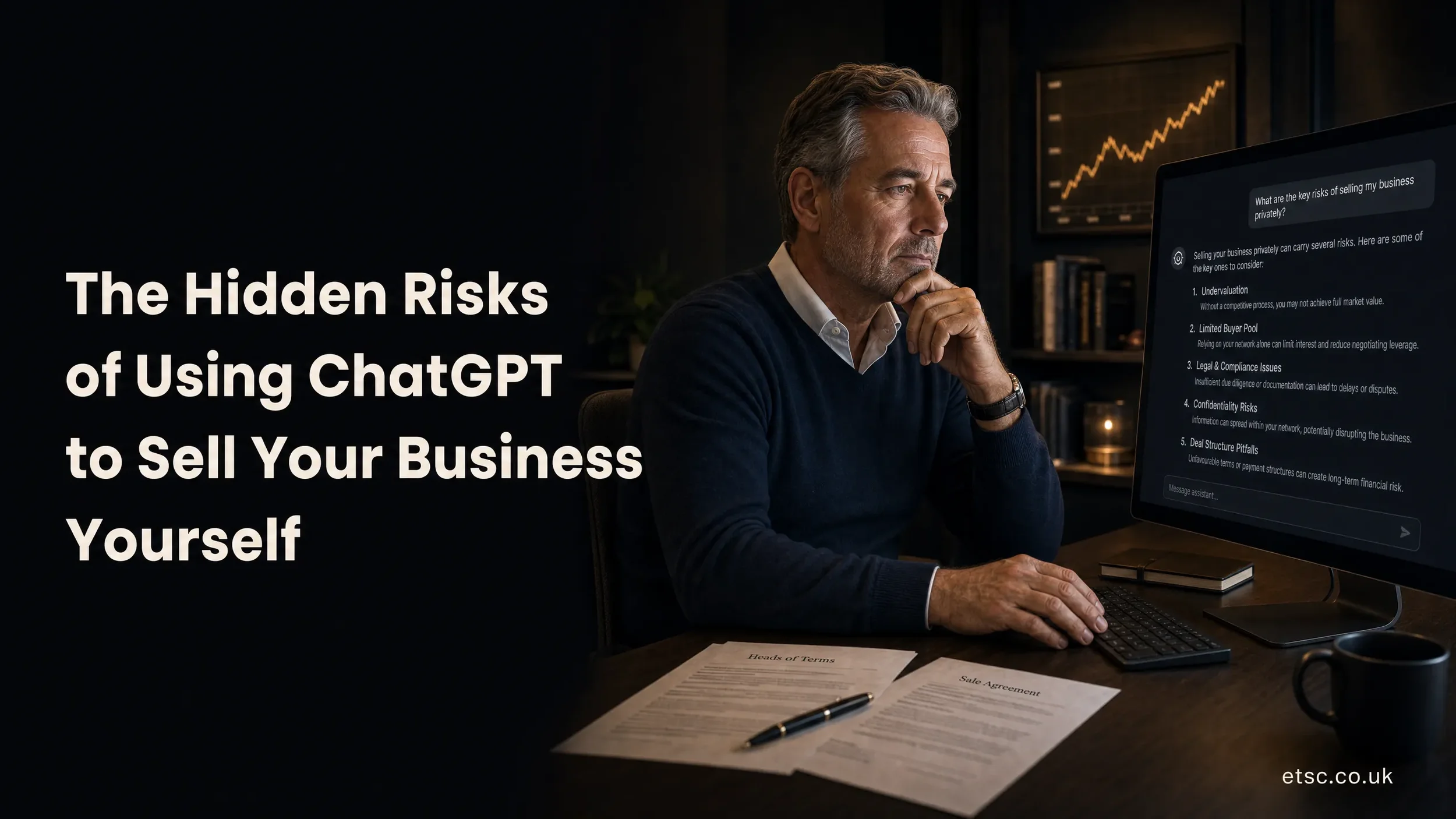
A founder said something to me recently that I suspect will become increasingly common, as more business owners turn to ChatGPT and other AI tools for a first opinion on what their business is worth.
"I put my figures into AI, and it says my business is worth £12 million. Is that about right?"
It was not an unreasonable question to ask. The answer he had received was fluently written, referred correctly to EBITDA multiples, and even explained why his business might sit towards the upper end of the range for his sector.
The trouble was that the answer was not really based on his business at all.
What the Figure Failed to Account For
It was based on the four or five figures he had typed in: turnover, profit, sector, and roughly how long the business had been trading. From those inputs, the AI tool had applied a plausible-sounding multiple and produced a number that carried the appearance of authority.
What it had no way of knowing was that two of his five largest clients accounted for nearly half of his revenue, or that his most effective salesperson was, in practice, himself. That, precisely eighteen months earlier, a broadly comparable business in the same sector had sold for a fraction of what he was expecting, because the buyer's due diligence had uncovered similar weaknesses his own business carried.
None of this was his fault. He had asked a reasonable question and received a confident, well-written answer in return. ChatGPT had done precisely what it was built to do. It was simply never built to know the factors that actually determine what a buyer will pay.
AI can give you a number. It has no way of knowing whether that number is right for your business, because it neither knows your business nor you. It knows the five things you typed in.
The Concern Is Not AI Itself. It Is What It Is Trusted With.
I want to be honest about this, because there is a great deal of noise online telling business owners either to fear AI or to embrace it without question, and neither position is quite right.
AI is genuinely useful for certain parts of selling a business. It will produce a clean first draft of an outreach email. It will help you organise your thinking about why you are selling and what you want next. It functions well as a thinking partner for the parts of the process that are largely about writing.
Where it fails is anything that depends on judgement built from having done this before, more than once, with real money and real consequences at stake.
Genuinely useful for
- Drafting and refining text once you know what to say
- Organising your own thinking about the business
- Speeding up admin and correspondence
- A rough first draft of an outreach message
Cannot be trusted with
- A defensible valuation
- Knowing what to disclose, when and to whom
- Finding the buyers who actually pay a premium
- Reading a room and knowing when to walk away
Over thirty years, I have sat across the table from enough buyers' negotiators to recognise a manufactured due diligence finding when I see one. I have watched an exhausted, unrepresented seller accept a £200,000 reduction in price because they had no energy left to argue the point. No amount of prompting produces that instinct. It comes only from doing this repeatedly, over decades, working with all shapes and sizes of businesses and personalities.
Five Places This Can Quietly Cost You Money
These are not hypothetical scenarios. They are the same small set of situations I see repeatedly, including among owners who had made extensive use of AI before they contacted me.
Sharing too much, too soon
An AI tool has no way of knowing who the buyer is, or whether they have signed any form of confidentiality agreement. Owners following generic advice found online often disclose margins, client names, and commercial strategy before any such agreement exists. Once that information has been shared, it cannot be recalled.
An Information Memorandum that reads as generic and templated
Ask AI to draft your Information Memorandum and the result will be competent but unremarkable. It has no way of knowing what makes your business specifically valuable to a particular buyer. Experienced acquirers recognise a generic document within minutes and adjust their negotiation approach accordingly.
A valuation with nothing behind it
The founder in this example had a number. He did not have a methodology that could withstand scrutiny from a buyer's finance team. Without that, there is nothing to defend the price with, and it will be tested.
Reaching the wrong buyers entirely
The buyers who pay a genuine premium are rarely the ones searching online for acquisitions. AI-generated outreach lists tend to surface financial buyers and consolidators, the type who prefer to be the only party at the table and most likely are not your ideal acquirers.
Losing the negotiation before it starts
A buyer can usually tell within the first exchange whether they are dealing with an experienced representative or an owner acting alone. That impression alone shapes how hard they push, and how much room they believe they have to negotiate.
What I Told Him
I did not tell the founder that his business was not worth £12 million. It might well have been. Equally, it might not.
What I told him was that the figure he had been given was a starting point for a conversation, not a conclusion. A proper valuation would need to examine how concentrated his revenue was among a small number of clients, how dependent the business genuinely was on him personally, what the true, normalised earnings looked like once one-off items were removed, and what comparable businesses in his sector had actually sold for, rather than what a generic multiple table suggested they should.
Asking the question had been entirely reasonable. The mistake would have lain in treating the answer as final.
What a Proper Assessment Actually Looks At
The figure the founder had been given looked at his business from a distance. A proper assessment looks at it from close up, and it looks at more than the business alone.
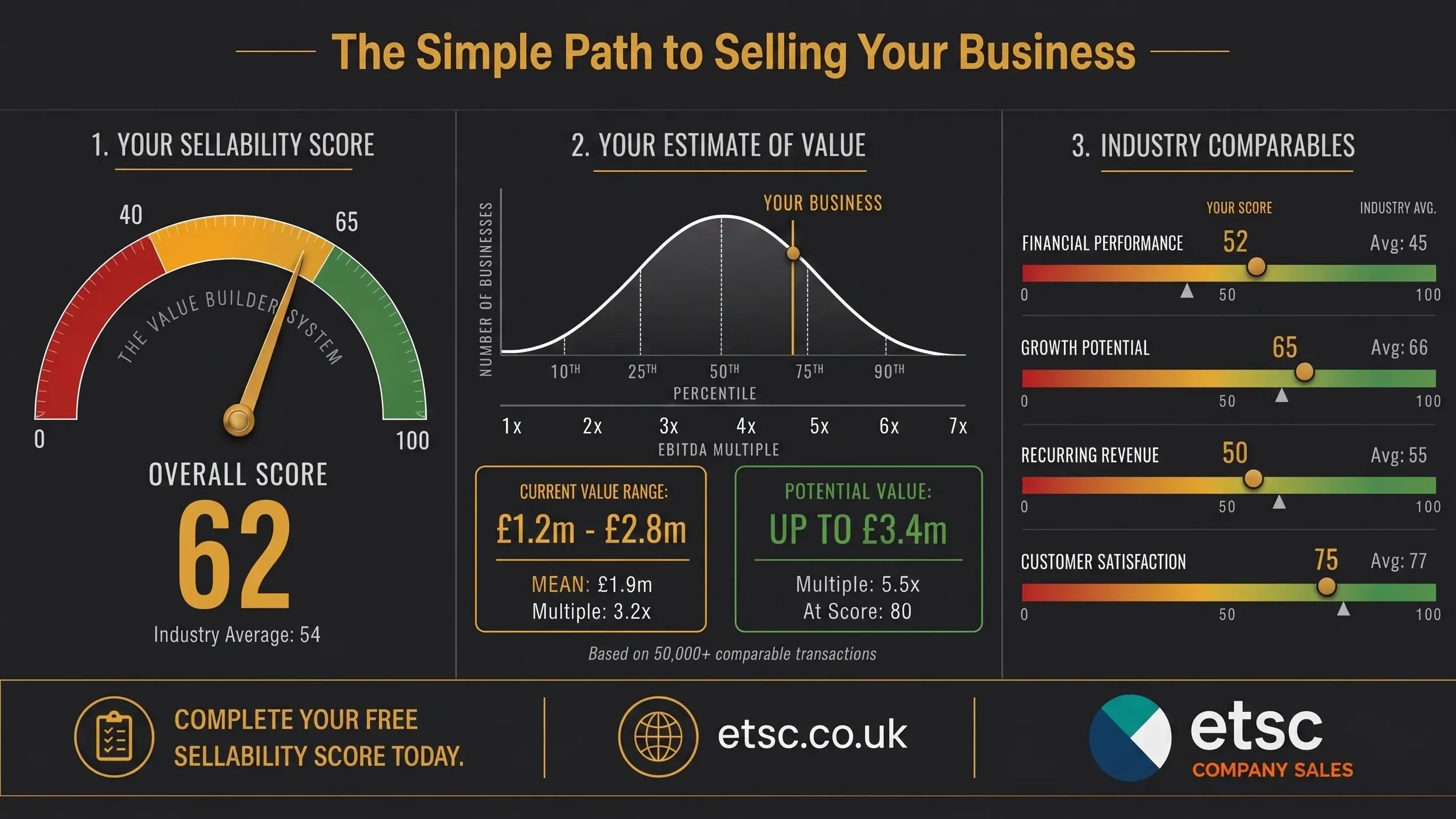
At ETSC, we use Value Builder, to understand the business itself in far more depth than turnover and profit allow. It examines the eight specific value drivers that determine what a buyer could actually pay and why, including recurring revenue, customer concentration, and how dependent the business is on its owner. You can see where your own business stands by taking the free Sellability Score assessment.
But the business is only one half of the picture. Selling a company is also a personal decision, and it needs to be treated as one. We use the Personal Readiness to Exit assessment, known as PREScore, to understand whether an owner is genuinely ready to let go, and the Freedom Score to understand what they actually need from a sale to achieve the life they want afterwards. Both are free to take: the PREScore assessment and the Freedom Score assessment.